
An institutional catering career like no other.
•No seasonal work fluctuations
• A good work-life balance
• Great Civil Service benefits
Quick facts (Back to top)
- Salary: £33k to £39k (depending on location).
- Locations: various public sector prisons.
- Contract: permanent.
- Shifts: 37 hour week shift pattern with no early starts, late nights or split shifts.
Key benefits (Back to top)
- Work in a professional, industrial sized kitchen that caters for an entire prison.
- Good job security in a secure environment.
- Apprenticeship and progression opportunities.
- Make a positive impact far beyond the kitchen.
Why choose prison catering? (Back to top)
Prison catering jobs provide an opportunity to put your professional catering skills into practice in a secure, stable environment while helping prisoners improve their future prospects.
Job security
Unlike commercial catering with seasonal fluctuations, prison kitchens operate 365 days a year – guaranteeing you stable employment.
Working patterns
Prison kitchens generally operate between 7am and 7pm, 7 days a week. You’ll work a 37-hour week shift pattern, with no late evenings. This will include some weekends and bank holidays, for which you’ll receive a 20% unsocial hours payment in addition to your basic pay.
Professional kitchen environment
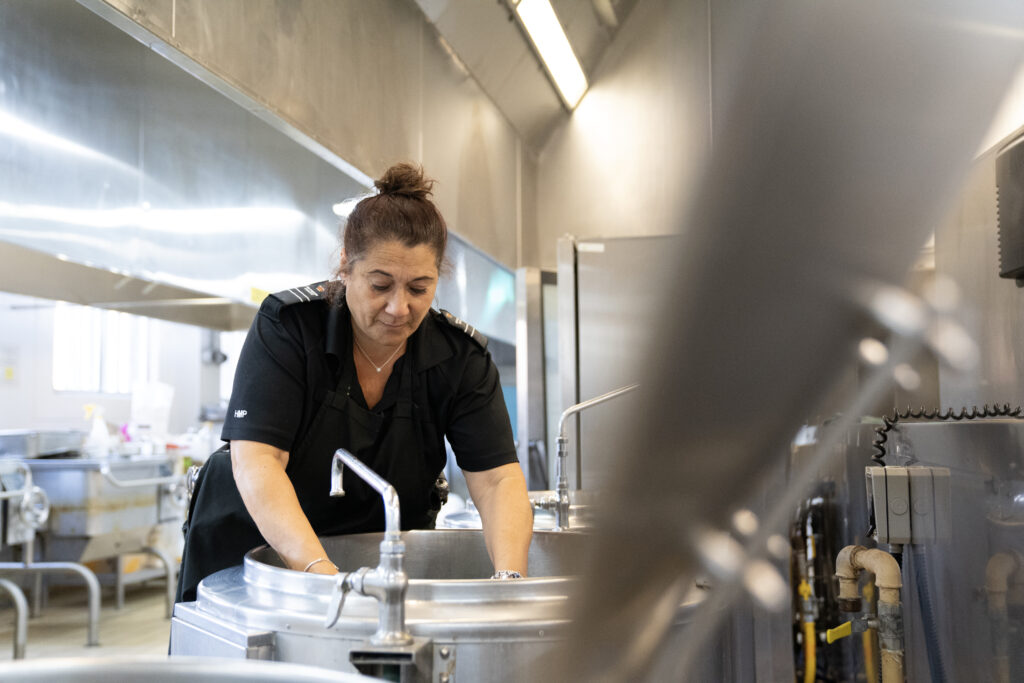
Work in a large, institution-sized kitchen with commercial-grade equipment.
Meaningful work
Being a prison caterer is an extraordinary job. Working alongside and supervising prisoners, you will be supporting them to learn new skills. This can support their rehabilitation by helping to increase their chances of employment when they leave prison.
Working in prison catering jobs (Back to top)
As a prison caterer working in an industrial-sized kitchen, your day will be meticulously planned. But you’ll need to be prepared for when things happen that throw you off schedule – such is the nature of working in a prison. You’ll need to be resourceful, flexible, efficient, creative, have a ‘can do’ attitude and be able to think on your feet.
Key responsibilities for prison caterers
- Prepare and cook hot, cold and packed meal options for hundreds of prisoners, catering for a range of dietary requirements.
- Work alongside and supervise prisoners who have been approved to work in the kitchen.
- Manage ingredient stock levels, ensuring minimum wastage.
- Sometimes you will need to do a trolley service, delivering meals to prisoners’ cells.
As a prison catering supervisor, you will be responsible for manging the staff and prisoner catering teams. This includes allocating daily tasks and providing food safety and health and safety training. You will also work with the catering manager to create menus, ensuring all special dietary requirements are catered for.
The logistics of running a prison kitchen on a limited budget can be a challenge, but it is never dull. You’ll need to be flexible and creative to make sure everyone gets a nutritious meal.
Coaching and supervising prisoners
Working alongside and supervising prisoners, you’ll be supporting them to learn new skills. This will increase their chances of employment when they leave prison and reduce their likelihood of reoffending. You’ll teach them health and safety in the kitchen, food hygiene practices and how to cook in bulk.
You may also be part of the selection process, deciding which prisoners to employ in the kitchen. Plus, you’ll be responsible for assessing their work, and writing reports for their training portfolio.
Seeing the change in the people you work with and helping them reach their goals can be an incredibly rewarding experience.
Read more about being a prison caterer in our blog (opens in a new tab).
Working environment and safety (Back to top)
It can be strange adjusting to working in a prison environment. Things like locking and unlocking multiple doors to get to your kitchen each day can take some getting used to, but most of our staff find that within a few days or weeks it becomes second nature.
Professional kitchen environment
Catering jobs in prisons involve working in the main prison kitchen or staff mess hall. You’ll work as part of a team in large, industrial-sized kitchens with commercial-grade equipment.
Safety and security
“I carry a radio, there are panic buttons around the kitchen if we need them, and processes to follow that keep everyone safe. I’ve never had to use any of them.”
Prisoners are assessed for their suitability to work in a prison kitchen and are searched at the beginning and end of their working shifts. You’ll play an important role in keeping your kitchen safe and will have robust processes and safety measures to follow, plus training, to support you.
Team work
In a prison catering job, you will work as part of a team alongside and supervising prisoners. Seeing the change in the people you work with and helping them reach their goals can be an incredibly rewarding experience.
Salary, benefits and rewards (Back to top)
Competitive package
Catering jobs in prisons are typically competitive with commercial catering, but with superior benefits and job security.
Your starting salary will depend on which prison you work at.
| Location | Prison caterer (Band 3) | Prison catering supervisor (Band 4) |
|---|---|---|
| Inner London | £39,493* | £45,979* |
| Outer London | £37,525* | £43,908* |
| Other locations | £33,746* | £39,930* |
* starting salary based on a 37-hour week including 20% unsocial hours allowance.
Benefits package
- Civil Service Pension: one of the best workplace pension schemes in the UK public sector.
- Annual leave: 25 days, increasing to 30 with long service, plus 8 public holidays.
- Working patterns: Work-life balance options such as part-time hours and job shares may be available, after you’ve completed your initial training.
- Free gym: use of the prison’s onsite gym.
Find out more about the benefits of working for HM Prison and Probation Service
Training and career development (Back to top)
Training
- When you start, you’ll receive training on how to work safely in a prison and with prisoners.
- You will need to complete food safety hygiene training every 3 years.
- Take advantage of earn while you learn apprenticeship opportunities.
Career progression
Band 3 caterers report into band 4 catering supervisors. Once you have passed your probationary period as a band 3 prison caterer, you could progress to be a band 4 catering supervisor, or progress further to be a catering manager.
What we’re looking for (Back to top)
- Experience in catering and preparing food for large numbers of people.
- Qualifications relevant for your role – see below for role-specific requirements.
- Good working knowledge of food legislation.
- Knowledge of current food, health and safety, and hygiene-related regulations for working in a kitchen.
- Confident communication and great team working and leadership skills.
- Strong organisational and time management skills.
Prison kitchens can be pressured environments, so you need to be able to remain calm and think on your feet.
Qualifications you’ll need for prison catering jobs
Prison caterer (band 3)
- a vocational qualification at level 3 or be willing to work towards one
- a level 2 certificate in food production within hospitality and catering or equivalent
- a food hygiene certificate at level 2
Catering supervisor (band 4)
- a level 2 certificate in food production within hospitality and catering or equivalent
- higher qualifications or be working towards them
- a food hygiene certificate at level 3 (intermediate level)
Once in post, you’ll need to complete food safety hygiene training every 3 years.
How to apply (Back to top)
Step-by-step application process
- Check if you’re eligible: You need to be 18 years, have the right to work in the UK and the Civil Service (GOV.UK, opens in a new tab) and speak fluent English, or Welsh in Wales where specified in the job ad. To work in a high security prison, you must have been resident in the UK for the last 3 years.
- Apply online: Tell us about your previous catering roles or college course, provide details of your catering qualifications, give real-life examples that show you can demonstrate the behaviours needed to be successful in the role, detail your employment history, relevant experience, skills and achievements.
- Attend an interview: This will be your opportunity to tell us more about yourself, your work history, and personal experiences.
- Complete your pre-employment checks: These will include security, identity and past-employment checks.
- Get an offer and arrange your start date: Once you have received your provisional offer and passed your pre-employment checks, we’ll email you to arrange when you can start your new prison caterer role.
Timeline
From application to start date: typically 3 months, including security clearance.
Preparing for your interview (Back to top)
We will use the Civil Service Success Profiles framework (GOV.UK, opens in a new tab) in your interview. This will assess the following:
Developing self and others: That you take time to coach, mentor and develop others, as well as reflecting on your own work and continuously seeking and acting on feedback.
Managing a quality service: That you take pride in yourself and your work, and demonstrate a strong work ethic. You manage your own time, quickly adapting to changing circumstances while adhering to processes and rules.
Making effective decisions: That you understand your own level of responsibility and make decisions where appropriate, consulting with others to ensure potential impacts are considered.
Working together: That you are a team player who develops good working relationships and are a positive and supportive team member
To work as a catering supervisor, you will also be assessed on:
Leadership: That you ensure those you work for you have a clear understanding of their tasks and timeframes. That you take into account individual needs and consider the impact of your and your team’s actions on others.
In your interview, we’ll also assess your ability to speak and understand English. This is a government requirement in a public-facing role such as this where you’ll be engaging with prisoners and other people.
Frequently asked questions (Back to top)
Yes. Prison kitchens follow robust processes and comprehensive safety protocols. You will be trained on how to work safely in a prison and with prisoners.
You will need: a vocational qualification at level 3 or be willing to work towards one, a level 2 certificate in food production within hospitality and catering or equivalent, plus a food hygiene certificate.
Yes, you will work alongside and supervise prisoners in the kitchen. It can be an incredibly rewarding element of the role seeing prisoners develop new skills and a more positive outlook for the future.
You will work a 37-hour week shift pattern, with no late evenings. This will include some weekends and bank holidays, for which you’ll receive a 20% unsocial hours payment in addition to your basic pay.
Yes, as a band 3 prison caterer you could progress to be a band 4 catering supervisor. And you can progress further to be a catering manager.
Related career opportunities (Back to top)
Before you apply, why not get more of a feel for if the role is a good match for your personal strengths and skills and explore other opportunities you might be interested in?
Ready to advance your prison catering career? (Back to top)
Want to be part of a catering team that makes an impact far beyond the kitchen? Our prison caterers are people just like.